

The Role of Intelligent Automation in Scaling a DME Business
Running a durable medical equipment business involves much more than supplying products to patients. Providers must coordinate referrals, verify insurance coverage, manage documentation, maintain accurate inventory records, arrange deliveries, and submit claims that meet payer requirements. As the number of patients and orders grows, these responsibilities can place considerable pressure on administrative teams.
For many organizations, the biggest obstacle to growth is not a lack of demand but the increasing complexity of daily operations. Manual processes that work well for a small team may become inefficient when a company expands into new markets, adds warehouses, or serves more referral partners.
Artificial intelligence and workflow automation offer practical ways to address these challenges. When implemented carefully, they can reduce repetitive work, improve information flow, and help management teams maintain operational consistency as the business grows.
Why Traditional DME Workflows Become Difficult to Scale
DME providers frequently depend on processes that span several departments. An order may begin with a referral, move through eligibility verification and authorization, proceed to fulfillment, and eventually reach billing and reimbursement.
Each stage depends on accurate information from the previous one. If a prescription is incomplete, an authorization is missing, or an inventory record is outdated, the entire process can slow down.
Disconnected systems make these problems worse. Employees may need to enter patient details into multiple applications, contact colleagues to confirm an order's status, or search through documents to find information that should already be available.
These inefficiencies create several business risks:
Longer processing times and delayed deliveries.
More administrative work caused by incomplete records.
Increased likelihood of billing errors and claim denials.
Limited visibility into inventory and order status.
Difficulty maintaining consistent procedures across locations.
Adding employees can temporarily increase capacity, but it does not necessarily eliminate the underlying causes of these problems. A more scalable approach involves improving the workflows themselves.
How AI Can Support Everyday DME Operations
Automating Document Intake
Referral documents and prescriptions often arrive through different channels and contain information in inconsistent formats. Employees must identify relevant details, determine whether required fields are present, and enter information into the appropriate systems.
AI-powered document processing can help extract patient details, organize incoming files, and flag potentially incomplete records. Optical character recognition and document classification can further reduce the need for manual sorting.
These tools are most useful when they integrate with the provider's core software. Extracted information can then move into the appropriate workflow rather than remaining isolated in a separate application.
Human review remains important when information is unclear or when a document affects clinical requirements, reimbursement, or compliance.
Building an Integrated Technology Environment
Implementing separate tools for every operational challenge can create a new set of problems. Even if each application performs its individual task well, employees may still have to move data between systems and reconcile inconsistent records.
A connected technology environment reduces this fragmentation. The core platform should support the essential processes of the business and integrate with external applications where specialized capabilities are required.
When evaluating solutions, providers should examine:
Integration capabilities: Can the platform exchange information with referral, billing, communication, and delivery systems?
Workflow flexibility: Can processes accommodate different products, payers, locations, and business rules?
Data visibility: Can employees and managers access reliable information about order status and operational performance?
Security controls: Are access permissions, encryption, audit trails, and appropriate contractual safeguards available?
Scalability: Can the system support increasing order volumes without requiring extensive manual workarounds?
Providers exploring dme ai technology should evaluate these foundational capabilities alongside individual AI features. An intelligent tool has limited value if it cannot access the information needed to perform its task or return results to the system employees use every day.
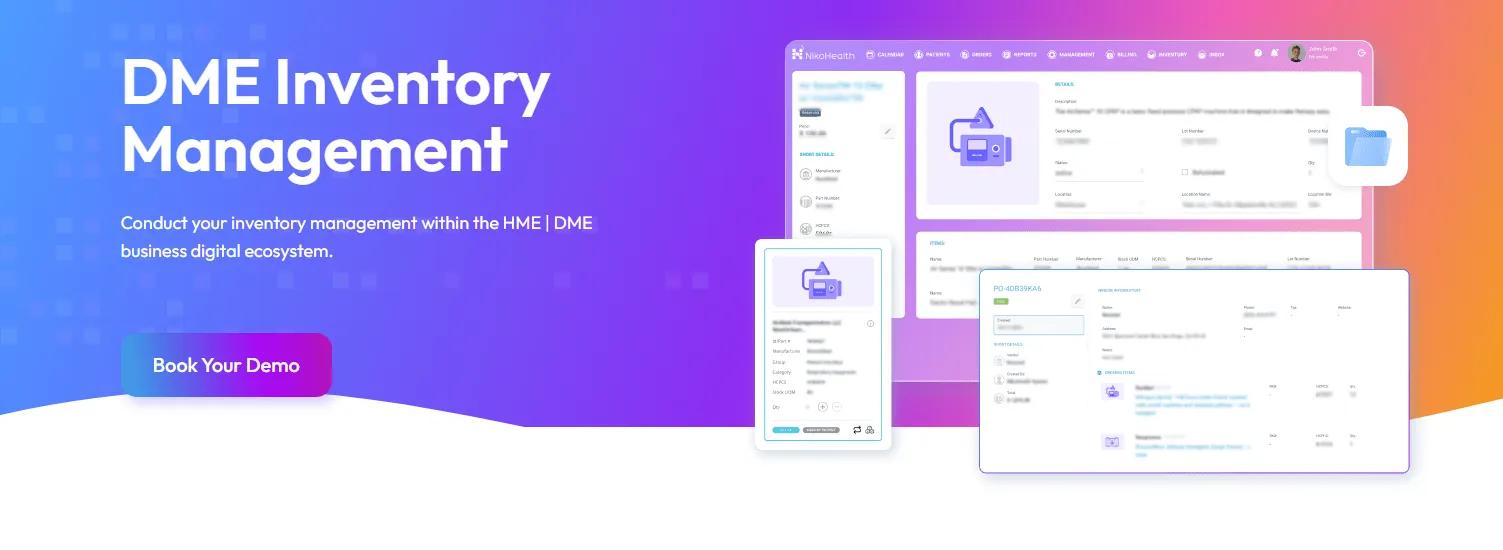
NikoHealth is an example of a cloud-based platform developed for HME and DME businesses. Its capabilities include order management, billing, inventory management, delivery workflows, resupply automation, and integrations with external services. A connected platform of this kind can provide the operational foundation for introducing additional automation in stages.
The appropriate solution will depend on the organization's size, existing infrastructure, implementation resources, and specific operational priorities.
A Practical Framework for Introducing AI
Successful automation does not require a company-wide transformation on the first day. A staged implementation allows providers to validate benefits, address technical problems, and build employee confidence before expanding the project.
Step 1: Identify the Most Expensive Bottlenecks
Begin by reviewing processes that create repeated delays or consume substantial staff time. Examples include manually sorting referral documents, checking order status, contacting patients for routine confirmations, and correcting preventable billing errors.
Interviews with employees can reveal practical problems that management reports do not fully capture.
Step 2: Establish Baseline Metrics
Before introducing a new tool, measure the current process. Useful indicators include average referral processing time, claim denial rate, authorization turnaround, delivery completion time, and employee hours spent on repetitive tasks.
These measurements provide a reference point for evaluating whether the technology produces meaningful improvements.
Step 3: Choose a Manageable Pilot
Select one workflow with a clear business objective and measurable results. For example, a provider might introduce automated reminders for eligible resupply patients or use document processing to organize incoming referrals.
A limited pilot makes it easier to identify errors, assess employee feedback, and estimate the financial impact without disrupting the entire organization.
Step 4: Integrate and Validate the Workflow
Confirm that the new tool exchanges information correctly with existing systems. Test routine cases, incomplete records, exceptions, and situations that require human intervention.
Security and compliance reviews should take place before sensitive patient information is processed by a new service.
Step 5: Expand Based on Evidence
After the pilot, compare actual results with the original baseline. Consider implementation costs, ongoing maintenance, training requirements, and any new administrative work introduced by the system.
Expand the project only when the results justify the investment and the workflow operates reliably.
Measuring the Return on Automation
The financial value of AI should be assessed through measurable operational outcomes rather than feature counts or vendor promises.
For example, a reduction in manual processing time may allow existing employees to handle more orders. Fewer preventable billing errors may reduce rework and support more predictable reimbursement. Better inventory visibility may help avoid unnecessary purchases and improve fulfillment planning.
A comprehensive evaluation should consider both direct and indirect costs, including software fees, integration work, employee training, maintenance, and the time required to monitor automated processes.
It is also important to distinguish between tasks that have been automated and tasks that have simply been transferred to another team. A workflow is not necessarily more efficient if employees must spend substantial time correcting automated outputs.
The strongest business case combines time savings, process reliability, financial performance, and service quality.
Security and Human Oversight Remain Essential
DME providers handle sensitive patient information, so any automation initiative must include appropriate safeguards.
Organizations should understand how vendors collect, process, store, and retain data. They should also review access controls, encryption, audit capabilities, applicable business associate agreements, and the procedures used to manage security incidents.
AI outputs should be validated when they affect patient records, billing decisions, or authorization workflows. Clear escalation procedures help employees identify cases that cannot safely be handled automatically.
Automation should support employees rather than remove accountability from the process. Human oversight is particularly important when information is ambiguous, payer requirements change, or a patient needs individualized assistance.
Preparing for Sustainable Growth
The future of DME operations will likely involve increasingly connected workflows, better use of operational data, and more targeted applications of artificial intelligence. Providers may gradually expand from basic task automation to demand forecasting, exception prioritization, and more sophisticated coordination between departments.
However, advanced capabilities deliver the greatest value when built on reliable data, consistent processes, and suitable software infrastructure.
DME businesses can prepare by documenting existing workflows, addressing data quality issues, improving system integration, and selecting measurable goals for each automation project.
AI is not a replacement for sound operational management. It is a way to make well-designed processes more efficient and easier to scale. By combining intelligent automation with connected software and appropriate human oversight, providers can reduce administrative friction, improve visibility, and build a stronger foundation for long-term growth.