

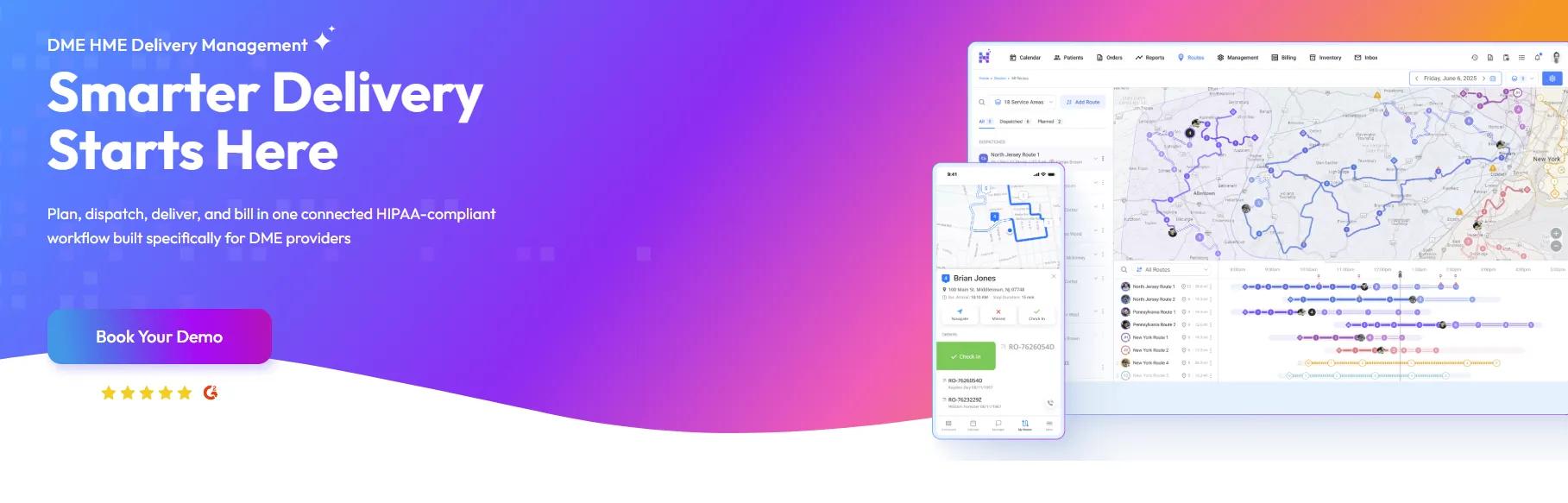
The delivery process is one of the most important parts of running a successful home medical equipment business. Patients depend on timely access to essential products, including wheelchairs, oxygen equipment, hospital beds, and respiratory supplies. At the same time, providers must coordinate drivers, manage inventory, control transportation costs, and maintain accurate documentation.
As order volumes grow, these responsibilities become increasingly difficult to handle with spreadsheets, phone calls, and disconnected software systems. Even small scheduling mistakes can lead to missed appointments, additional mileage, frustrated patients, and delays in reimbursement.
Improving delivery operations requires more than adding vehicles or hiring additional drivers. Medical equipment providers need standardized workflows, reliable communication, and technology that connects the warehouse, dispatch team, field staff, and billing department.
Why Delivery Operations Matter for DME Providers
Durable medical equipment delivery differs from conventional package transportation. Many deliveries involve products that patients need for everyday activities or ongoing treatment. Drivers may also need to assemble equipment, demonstrate its operation, collect signatures, and confirm that the correct items have reached the intended recipient.
These additional responsibilities create several operational challenges.
Scheduling complexity. Deliveries must accommodate patient availability, healthcare facility discharge schedules, equipment requirements, and geographical constraints. A single delayed appointment can affect the rest of the driver's route.
Inventory coordination. Dispatchers need accurate information about available equipment, warehouse locations, and products assigned to individual orders. Without this visibility, teams risk scheduling deliveries for items that are unavailable.
Five Ways to Make Medical Equipment Deliveries More Efficient
1. Standardize the Scheduling Process
An effective delivery operation starts with a consistent scheduling procedure. Before assigning an order to a driver, staff should confirm the delivery address, contact information, equipment availability, required documentation, and any special handling instructions.
Providers should also distinguish between routine deliveries and urgent requests. Hospital discharge equipment, for example, may require a different scheduling priority from a standard replacement order.
Creating clear scheduling rules helps dispatchers make decisions consistently and reduces the likelihood of conflicting appointments.
It is also useful to establish realistic delivery windows. Promising an arrival time that drivers cannot reasonably meet creates unnecessary pressure and increases the number of customer service calls.
A centralized scheduling system can give employees a shared view of upcoming deliveries, outstanding orders, and potential conflicts. This makes it easier to redistribute workloads when a driver becomes unavailable or an urgent request arrives.
2. Optimize Routes Instead of Relying on Manual Planning
Route planning has a direct influence on delivery costs and daily productivity. When dispatchers arrange stops manually, they may overlook opportunities to group nearby appointments or account for changing traffic conditions.
Route optimization software helps organize stops according to location, delivery windows, vehicle capacity, and driver availability. More advanced solutions can also support adjustments when new orders arrive or unexpected delays occur.
For DME suppliers, efficient routing should account for more than distance alone. A delivery involving equipment setup may require more time than a straightforward product drop-off. Dispatchers should consider these differences when calculating schedules.
Providers can begin by reviewing several basic metrics:
Average miles driven per completed delivery.
Percentage of deliveries completed within the promised window.
Number of deliveries completed per driver each day.
Frequency of unsuccessful delivery attempts.
Fuel and labor costs per completed stop.
Tracking these indicators makes it easier to identify inefficient territories, overloaded routes, and recurring scheduling problems.
3. Connect Inventory Management With Delivery Planning
A delivery schedule is only useful when the equipment is available and ready to leave the warehouse.
Inventory discrepancies can create a chain reaction: an employee assigns an unavailable product to an order, the warehouse discovers the shortage, and dispatch must reschedule the delivery. The patient experiences the delay, while staff spend additional time resolving the problem.
To prevent these situations, providers should maintain accurate inventory records and connect equipment allocation with order fulfillment.
Useful capabilities include real-time stock visibility, product reservation, serial number tracking, warehouse-level inventory records, and alerts for low stock.
Equipment history is particularly important when managing serialized or reusable products. Knowing where an item is located, whether it requires maintenance, and which order it belongs to helps prevent assignment errors.
Inventory and delivery teams should also establish a clear process for handling substitutions, damaged products, and unexpected shortages. Every exception should be recorded so that dispatchers can update schedules before the driver departs.
When inventory data and delivery planning work together, providers can make more reliable commitments to patients and reduce unnecessary trips.
4. Equip Drivers With Mobile Tools
Drivers frequently encounter situations that require immediate updates. A patient may be unavailable, an address may be incorrect, or the delivered equipment may require additional documentation.
When field employees must call the office for every update or complete paperwork after returning to the warehouse, information can become delayed or incomplete.
Mobile delivery applications allow drivers to access assigned orders, review delivery instructions, update statuses, and record completion directly from the field.
Depending on the solution, these applications may also support electronic signatures, delivery confirmations, photographs where appropriate, and exception reporting.
The main advantage is that delivery information becomes available to office staff without waiting for paper records to return.
Mobile tools also help establish a more consistent documentation process. Instead of relying on individual drivers to remember every required step, organizations can build standard procedures into the delivery workflow.
Providers should train drivers to use these tools correctly and establish procedures for situations in which connectivity is unavailable. Technology works best when it supports a clear operational process rather than replacing one with an unfamiliar system.
5. Connect Delivery Completion to Billing
The final delivery step has implications beyond logistics. Incomplete delivery records can prevent billing teams from moving an order forward, even when the equipment has already reached the patient.
For this reason, delivery management should be connected to the broader revenue cycle.
When an authorized driver confirms delivery and completes the required documentation, the system should make that information available to the relevant back-office employees. Where supported by the organization's workflow and payer requirements, completed delivery events can trigger the next billing step.
This reduces the need for employees to manually reconcile delivery schedules against billing records.
However, delivery confirmation should not be confused with automatic claim approval. Providers must still satisfy applicable payer requirements, verify that the supporting documentation is complete, and follow the relevant billing rules.
A well-connected workflow helps staff identify missing information sooner and reduces delays caused by manual handoffs between departments.
What to Look for in DME Delivery Management Software
Selecting the right technology requires an understanding of the organization's delivery volume, service area, equipment categories, and existing systems.
A general-purpose route planner may be sufficient for a small operation with straightforward deliveries. A growing provider with multiple warehouses, complex equipment requirements, and integrated billing workflows may need a more comprehensive platform.
When evaluating dme delivery management capabilities, consider the following features:
Route planning and dispatch. The system should help dispatchers assign orders, organize stops, and respond to changes in delivery schedules.
Real-time delivery visibility. Office staff should be able to monitor delivery progress and identify delayed or unsuccessful stops without repeatedly contacting drivers.
Mobile documentation. Drivers should have access to relevant order details and a convenient way to capture delivery confirmations and required signatures.
Inventory integration. Delivery assignments should reflect equipment availability and help prevent conflicting allocations.
Exception management. The platform should make it easy to record missed appointments, damaged products, rescheduling requests, and other operational issues.
Billing connectivity. Delivery completion data should flow into the appropriate administrative workflows, reducing repetitive data entry and unnecessary delays.
Reporting and analytics. Managers should be able to evaluate route efficiency, on-time performance, delivery costs, and recurring operational bottlenecks.
Scalability. The software should accommodate increasing order volumes, additional drivers, and new service territories without requiring the organization to rebuild its processes.
Providers should also evaluate implementation requirements, employee training, data migration, and integration with their existing systems. A long feature list is less valuable if the software creates additional work for the people expected to use it.
Building a More Reliable Delivery Operation
Efficient medical equipment delivery requires coordination across scheduling, inventory, transportation, documentation, and billing. Improving only one part of the process may produce limited results if the other departments continue to rely on disconnected information.
Providers can make meaningful progress by standardizing order preparation, optimizing routes, connecting inventory with fulfillment, equipping drivers with mobile tools, and ensuring that completed deliveries reach the appropriate administrative teams.
Technology can support each of these improvements, but successful implementation also depends on clear responsibilities, realistic performance targets, and consistent staff training.
As a DME business grows, these practices become increasingly important. A reliable delivery process helps control operating costs, supports accurate documentation, improves the patient experience, and creates a stronger foundation for sustainable growth.