

How DME Providers Can Improve Patient Compliance With Automated Resupply Outreach
How DME Providers Can Improve Patient Compliance With Automated Resupply Outreach
Durable medical equipment (DME) providers depend on consistent communication to keep patients supplied with the products they need. From CPAP accessories and respiratory supplies to wound care products and other recurring medical essentials, timely resupply helps patients maintain their routines while supporting predictable revenue for suppliers.
However, managing recurring orders is rarely as simple as sending a reminder. Patients may overlook emails, ignore unfamiliar phone numbers, forget reorder dates, or struggle to complete an order confirmation. Meanwhile, administrative teams must balance outreach with insurance verification, billing, inventory management, and delivery coordination.
For growing DME businesses, these challenges can result in missed orders, unnecessary follow-up work, and gaps in patient compliance. A more effective approach combines automated reminders, convenient ordering options, and intelligent voice communication to make the resupply process easier for everyone involved.
Why Traditional Resupply Processes Often Fail
Many DME suppliers still depend on manual phone calls, spreadsheets, and individual staff members remembering when patients need their next shipment. Although these methods can work for smaller patient populations, they become increasingly difficult to manage as order volumes grow.
Several recurring problems contribute to missed resupply opportunities.
Patients overlook reminders
Patients receive communications from healthcare providers, pharmacies, insurers, and other organizations every day. An email about an upcoming supply order can easily disappear among other messages. Text notifications may also go unanswered if their purpose is unclear or the patient is busy.
Phone calls introduce another challenge. Patients frequently ignore unknown numbers because they associate them with spam or unwanted sales calls. Even when a patient genuinely needs supplies, the provider may struggle to establish contact.
Manual follow-ups consume staff time
When an initial reminder receives no response, employees must decide whether to send another message, place a call, leave a voicemail, or postpone the order. Repeating these tasks across hundreds or thousands of patients creates a substantial administrative burden.
Staff members may also need to document each attempt and update order statuses manually. Without a centralized workflow, it becomes harder to identify which patients have confirmed their orders and which still require assistance.
Complicated ordering discourages participation
A patient may be willing to reorder but abandon the process when asked to navigate a complicated portal, remember login credentials, or provide information that the supplier already has.
Every additional step creates another opportunity for an incomplete order. Simplifying the confirmation process can therefore be just as important as improving the reminder itself.
The Role of Automation in DME Resupply
Automated resupply systems help providers move away from manually tracking every recurring order. Instead of relying entirely on employee reminders, suppliers can configure workflows around product requirements, payer rules, patient eligibility, and previous order activity.
Once the relevant conditions are established, the system can identify upcoming resupply opportunities and initiate communication at the appropriate time.
A well-designed workflow can include:
Automated reminders based on expected reorder dates.
Text messages and emails tailored to the patient and product.
Convenient order confirmation through secure links.
Follow-up sequences for patients who have not responded.
Centralized visibility into confirmation and fulfillment status.
Integration with inventory, order management, and billing processes.
Automation does not eliminate the need for human oversight. Rather, it allows employees to focus on cases that require attention instead of spending most of their time repeating routine tasks.
For example, NikoHealth provides DME/HME resupply capabilities that combine automated outreach with streamlined order confirmation. Patients can confirm orders through secure links without downloading an additional application or remembering another password. Confirmed orders can then move into the supplier's broader operational workflow.
How Voice AI Improves Patient Outreach
Text messages and emails provide convenient ways to communicate, but they do not work equally well for every patient. Some individuals prefer speaking with someone, while others rarely respond to written reminders.
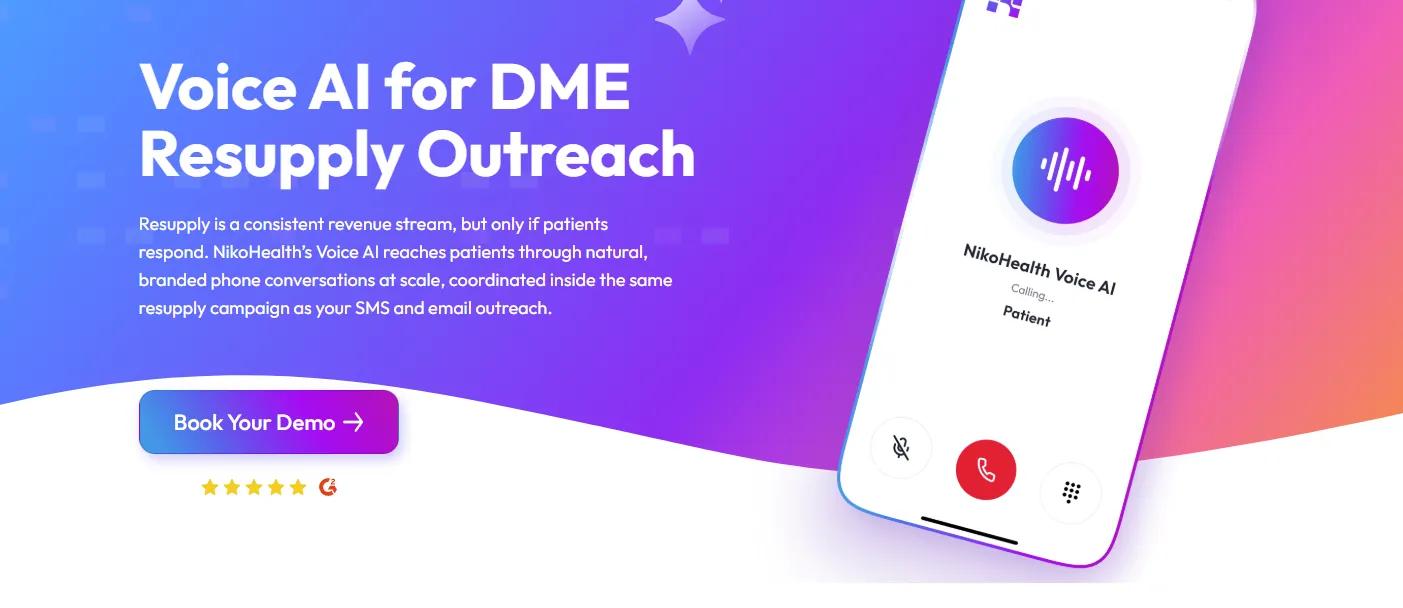
Voice AI introduces another communication channel by allowing automated systems to conduct phone conversations using predefined workflows and conversational capabilities.
Instead of relying exclusively on prerecorded announcements, a voice AI agent can explain the reason for the call, ask relevant questions, capture a patient's response, and determine the appropriate next step within its authorized workflow.
For DME providers, this approach can support several activities.
Reaching patients who have not responded
A supplier might begin with an SMS or email notifying a patient that supplies are due for reorder. If the patient does not respond within the configured period, the workflow can initiate a phone call.
During the conversation, the voice agent can explain which supplies are due and ask whether the patient would like to proceed. The response can then be recorded for the next stage of the process.
This creates another opportunity to reach the patient without requiring an employee to manually call every unresponsive contact.
Collecting straightforward order information
Some resupply conversations involve predictable questions about whether the patient needs another shipment or wishes to speak with the supplier.
A properly configured voice agent can handle these routine interactions within defined boundaries. More complicated situations, such as changes in clinical needs, prescription concerns, complaints, or uncertain insurance coverage, should be routed to qualified staff.
This division of work allows automation to handle repetitive communication while preserving human involvement where judgment is necessary.
Maintaining consistent communication
Manual outreach can vary depending on workload, employee availability, and individual communication styles. Automated voice workflows help standardize routine messages and follow-up timing.
Consistency is particularly valuable for providers managing large patient populations across multiple locations. Every eligible patient can enter the appropriate workflow rather than depending on whether an employee remembers to make a call.
What Do Suppliers Use to Reduce Resupply No-Shows and Improve Compliance?
DME suppliers increasingly rely on coordinated communication workflows rather than a single reminder method. The goal is to make it easier for patients to respond, confirm their needs, and receive supplies on schedule.
A practical strategy combines several elements.
1. Multichannel patient communication
SMS, email, and voice calls serve different purposes. Text messages offer quick access to confirmation links, emails provide additional information, and phone conversations give patients an opportunity to clarify questions.
The most effective combination depends on patient preferences, communication history, operational requirements, and the nature of the supplies being ordered.
Providers looking to understand how conversational phone outreach fits into this process can explore what do suppliers use to reduce resupply no-shows and improve compliance? A closer look at voice AI for resupply outreach can help explain how automated calls complement traditional communication channels.
2. Timely, eligibility-based reminders
Sending reminders too early may confuse patients, while contacting them too late can contribute to supply interruptions.
Suppliers should configure outreach around the relevant reorder schedule, product requirements, and applicable payer guidelines. Automated eligibility tracking can help identify the appropriate time to initiate the process.
These workflows should account for payer-specific frequency limits and other requirements rather than assuming every patient can reorder on the same schedule.
3. Simple order confirmation
Patients should not have to navigate unnecessary administrative steps to confirm a routine order. Secure confirmation links and clearly written messages can reduce friction and make the next action obvious.
Where appropriate, messages can identify the product and explain how the patient can review or confirm the order. Clear information helps prevent confusion, particularly when patients manage several medical products.
4. Automated follow-ups with sensible limits
One unanswered message should not necessarily end the process. A supplier can configure follow-up communication for patients who have not responded, using a sequence that balances persistence with respect for patient preferences.
For example, a workflow may begin with a text message, send an email if necessary, and initiate a voice call after a defined interval.
Communication frequency should remain reasonable, and patients must have appropriate options to decline or request assistance. Suppliers should also follow applicable privacy, consent, and telecommunications requirements.
5. Human escalation for exceptions
Not every patient interaction should be automated from beginning to end. A patient may report a change in condition, request a different product, dispute an order, or need help understanding insurance coverage.
The system should recognize when a conversation falls outside its permitted workflow and transfer the case to an appropriate employee.
This ensures that automation supports the patient experience rather than becoming a barrier to assistance.
Conclusion
Reliable resupply operations require more than sending reminders. DME suppliers need a coordinated process that reaches patients at appropriate times, makes order confirmation straightforward, and connects patient responses with fulfillment and billing.
Automated SMS and email reminders can reduce repetitive outreach, while voice AI provides an additional way to engage patients who do not respond to written messages. When these channels operate alongside eligibility checks, order management, and clear escalation procedures, suppliers can improve workflow consistency without removing the human support patients sometimes need.
The most effective approach is to combine convenient communication with responsible automation and measurable operational goals. By monitoring response rates, confirmed orders, fulfillment performance, and patient feedback, DME providers can refine their resupply programs and build a more dependable experience for both patients and staff.