

How AI-Powered Document Workflows Can Improve Efficiency in the DME Industry
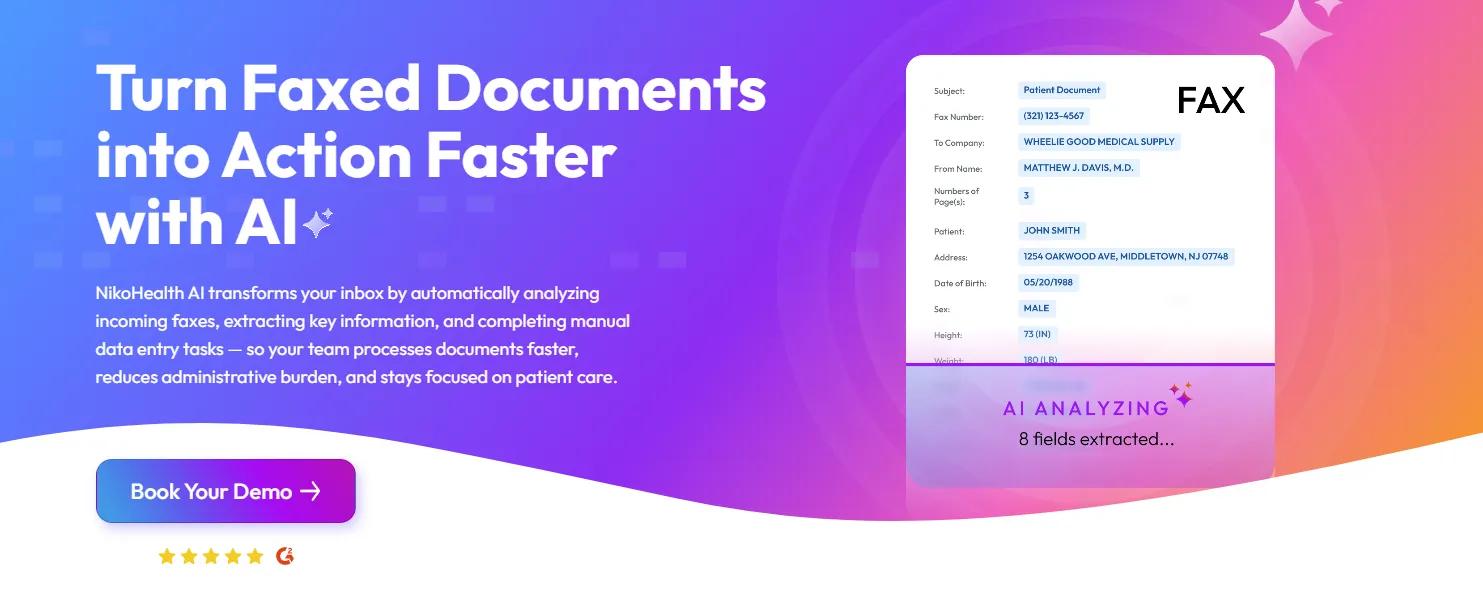
Durable medical equipment (DME) providers manage a constant flow of prescriptions, referral forms, medical necessity documentation, insurance authorizations, and delivery records. Although these documents are essential to daily operations, processing them manually can consume hours of staff time and create bottlenecks that affect billing, order fulfillment, and patient service.
Fax communication remains an important part of this process. Physicians, hospitals, insurance companies, and medical equipment suppliers frequently exchange paperwork through fax systems, even when other parts of their operations have moved to digital platforms. The result is a hybrid workflow in which employees must review incoming documents, identify the relevant patient, enter information into business software, and follow up on missing details.
Artificial intelligence offers a practical way to improve this process. By combining document recognition, automated classification, information extraction, and workflow routing, DME organizations can reduce repetitive administrative work while maintaining oversight of critical decisions.
Why Fax Processing Remains a Challenge for DME Providers
DME businesses operate at the intersection of healthcare documentation, insurance requirements, inventory management, and patient fulfillment. A single order may involve several documents, and each document must reach the appropriate person or department before the order can proceed.
Common challenges include:
Manual document sorting: Employees open incoming faxes and determine whether each file contains a prescription, referral, authorization, or supporting clinical record.
Repeated data entry: Patient demographics, insurance details, order information, and provider identifiers may need to be entered into multiple systems.
Missing documentation: An incomplete prescription or missing signature can delay order processing and create additional follow-up work.
Unclear task ownership: Documents can remain in shared inboxes when no employee is explicitly responsible for the next action.
Limited visibility: Managers may struggle to determine which orders are waiting for paperwork and which have already been processed.
These problems become more noticeable as a provider expands into additional locations, serves more referral partners, or adds new product categories. Hiring more administrative staff can help, but it does not necessarily eliminate the underlying inefficiencies.
A better approach is to improve how information moves through the organization.
How AI Changes the Document Management Process
Traditional digital fax solutions primarily focus on transmitting, receiving, and storing documents. AI-enabled systems can go further by interpreting document contents and helping initiate the next step in a business workflow.
The technology can support several connected activities.
1. Intelligent Document Classification
AI-powered document recognition can analyze incoming files and categorize them according to their contents. A system might identify a prescription, referral, certificate of medical necessity, insurance authorization, or delivery-related document.
Classification helps reduce the amount of time employees spend opening files individually and deciding where each one belongs.
However, classification should not be treated as infallible. Poor-quality scans, unusual document formats, and ambiguous information can lead to mistakes. Organizations should establish confidence thresholds and send uncertain documents to an employee for review.
2. Information Extraction
After identifying a document type, an AI system may extract relevant information, including patient names, dates of birth, ordering physicians, insurance details, product descriptions, and prescription dates.
The extracted information can then be compared with existing records or transferred into connected business applications.
This step is particularly useful when teams process large volumes of repetitive paperwork. Instead of retyping every field, employees can focus on validating the information and resolving exceptions.
3. Patient and Order Matching
A document is useful only when it is associated with the correct patient and order.
Automated matching can compare identifying details against existing records and suggest the appropriate destination. When the system detects conflicting information or multiple possible matches, it should request human confirmation rather than automatically modifying the wrong record.
Accurate matching is especially important for providers that manage multiple locations, large patient populations, and complex ordering workflows.
4. Workflow Routing and Follow-Up
Once a document has been classified and matched, the system can route it to the appropriate queue. A prescription may go to intake, an authorization letter may require billing review, and an incomplete referral may generate a follow-up task.
Automated routing makes responsibilities clearer and reduces the likelihood that important paperwork will remain unattended.
It can also support notifications and status tracking, allowing managers to identify documents that have exceeded internal processing targets.
The Connection Between Fax Management and Revenue Cycle Performance
Document management is not simply an administrative concern. It can directly affect a DME provider's ability to complete orders and receive reimbursement.
Consider a typical workflow. A physician sends a prescription, the intake team reviews the paperwork, insurance requirements are checked, and the order moves toward fulfillment. If required documentation is missing, the process may stop until the provider or another party supplies the necessary information.
When these delays accumulate, the organization may experience slower order completion, additional employee workload, delayed claim submission, or avoidable rework.
AI-supported document workflows can help address these issues by identifying missing information earlier and making the status of each order easier to track.
The potential benefits include:
Faster handling of routine incoming documents.
Fewer repetitive data-entry tasks.
Earlier identification of incomplete paperwork.
Better coordination between intake, billing, and operations.
More consistent documentation workflows.
Improved visibility into outstanding tasks.
These improvements do not guarantee faster reimbursement or fewer claim denials. Outcomes depend on document quality, payer requirements, integration capabilities, and the accuracy of the underlying workflow. Nevertheless, reducing preventable administrative delays can support a more predictable revenue cycle.
What to Look for in AI Fax Management for DME Providers
Selecting an automation solution requires more than checking whether it includes optical character recognition or artificial intelligence. DME organizations should evaluate how the technology fits their operational requirements.
Integration With Existing DME Software
Document automation becomes more valuable when it works with the systems employees already use.
Providers should determine whether a solution can exchange information with their DME management platform, billing software, patient records, and other operational applications. They should also clarify whether integration is native, API-based, or dependent on manual exports and imports.
Without reliable integration, automation may simply move the data-entry burden to another part of the workflow.
Support for Industry-Specific Documentation
General-purpose document processing may not adequately address the requirements of DME operations.
The system should be evaluated against the documents the organization actually receives, including prescriptions, medical necessity records, authorization letters, and supporting clinical information.
Testing should include incomplete forms, low-resolution scans, handwritten entries, duplicate documents, and variations in provider paperwork.
Security and Access Controls
DME organizations handle protected health information, making security a fundamental requirement.
Potential solutions should be evaluated for encryption, user permissions, audit logging, secure document retention, and appropriate contractual safeguards. Providers should also determine how vendors handle AI processing, data storage, and access by third parties.
HIPAA-related responsibilities do not disappear when a workflow is automated. The provider remains responsible for ensuring that its processes and vendor arrangements meet applicable requirements.
Human Review and Exception Handling
Automation should not mean removing people from every decision.
A reliable system needs a clear process for handling unreadable documents, conflicting patient information, missing signatures, and uncertain extracted values. Staff should be able to inspect the original document, correct mistakes, and see what actions have already occurred.
These safeguards help prevent a small recognition error from becoming a larger operational problem.
The Future of Document Automation in DME
AI-enabled document processing is likely to become increasingly connected to broader healthcare administrative workflows. Rather than simply converting a fax into a digital file, more advanced systems can help interpret its contents, identify missing information, update connected records, and direct work to the appropriate team.
For DME organizations, the greatest opportunity lies in connecting these capabilities to the complete order lifecycle. A prescription is not merely a document to store; it is a potential starting point for intake, verification, authorization, fulfillment, and billing.
That broader perspective is also important when assessing <strong>ai fax management for dme providers</strong>. The strongest solutions will not necessarily be those that automate the largest number of isolated tasks. They will be those that improve the flow of accurate information while preserving the controls required for healthcare administration.
DME businesses should approach adoption with clear goals, realistic expectations, and measurable performance indicators. By combining intelligent document processing with appropriate human oversight and integrated operational software, providers can reduce repetitive work and create more consistent administrative processes.
The ultimate objective is straightforward: spend less time chasing paperwork and more time ensuring that orders move through the business accurately, efficiently, and with the documentation needed to support patient service and reimbursement.