

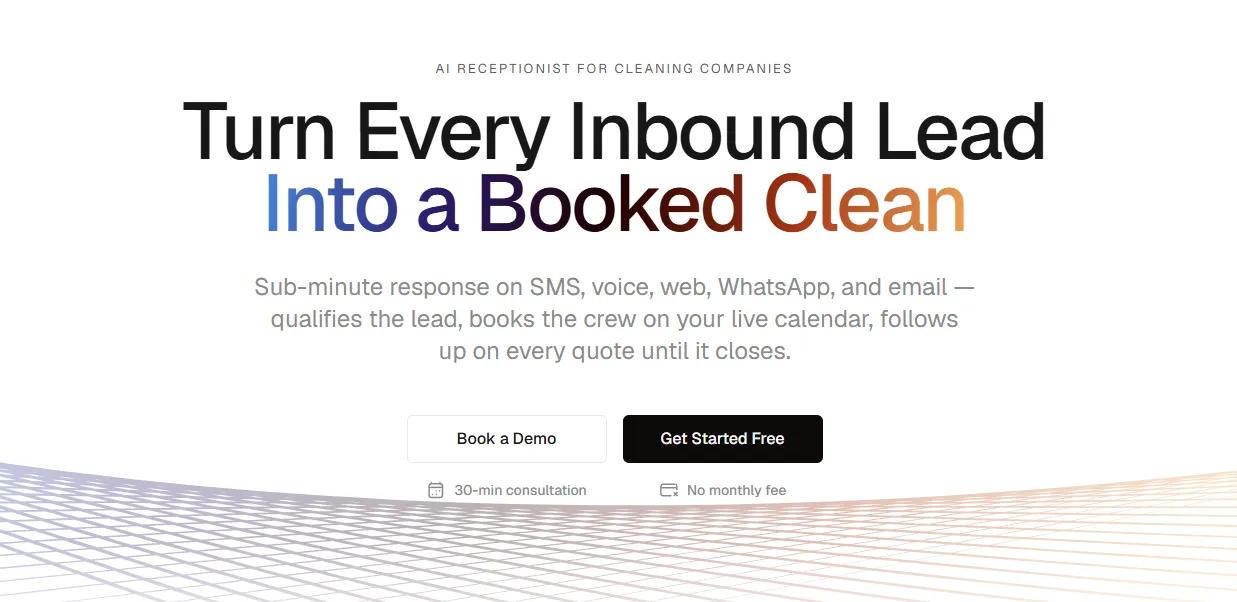
The cleaning industry has always been highly service-driven, relying on fast communication, accurate scheduling, and strong customer relationships. Whether it’s residential cleaning, commercial janitorial services, or specialized sanitation contracts, success often depends on how quickly and effectively a company responds to client inquiries.
In recent years, artificial intelligence has begun reshaping how cleaning businesses manage customer interactions. One of the most impactful innovations is the rise of the ai receptionist for cleaning companies, a technology that automates front-desk communication, handles bookings, answers questions, and ensures no customer request goes unanswered.
This article explores how AI receptionists work, why they are becoming essential in the cleaning industry, and how they can significantly improve efficiency, customer satisfaction, and revenue growth.
What Is an AI Receptionist?
An AI receptionist is a virtual assistant powered by artificial intelligence that performs the core duties of a human receptionist. In the cleaning industry, it is designed to manage tasks such as:
Answering incoming phone calls and messages
Responding to customer inquiries in real time
Scheduling and rescheduling cleaning appointments
Providing pricing estimates based on predefined rules
Sending reminders and confirmations
Collecting customer information and service details
Unlike traditional voicemail systems or basic chatbots, AI receptionists use natural language processing (NLP) and machine learning to understand context, interpret customer intent, and respond in a human-like manner.
For cleaning companies that receive a high volume of inquiries throughout the day, this technology ensures that no lead is missed—even outside business hours.
Why Cleaning Companies Need AI Receptionists
Cleaning businesses face unique operational challenges. Customer requests often come in unpredictably, and many potential clients expect immediate responses. If a company fails to respond quickly, customers may move on to competitors.
Here are some of the key reasons why AI receptionists are becoming essential:
1. Missed Calls Mean Lost Revenue
A significant portion of cleaning business leads come from phone calls or online inquiries. If a call is missed, there is a high chance the customer will not call back. Human receptionists can only handle one conversation at a time, while AI can manage hundreds simultaneously.
2. After-Hours Inquiries
Customers often search for cleaning services in the evening or on weekends. Without an AI system, these inquiries go unanswered until the next business day, reducing conversion rates.
3. High Administrative Workload
Cleaning companies must manage scheduling, cancellations, employee dispatching, and customer follow-ups. An AI receptionist reduces the burden on staff by automating repetitive tasks.
4. Scaling Without Increasing Staff
As cleaning companies grow, hiring additional administrative staff becomes expensive. AI receptionists allow businesses to scale operations without proportionally increasing overhead costs.
How AI Receptionists Work in Cleaning Businesses
The functionality of an AI receptionist for cleaning companies is built on several integrated technologies:
Natural Language Processing (NLP)
NLP allows the system to understand customer messages, even when they are informal or unclear. For example, if a customer says, “I need my apartment cleaned next week sometime,” the AI can interpret intent and request clarification.
Automated Scheduling Systems
AI receptionists connect directly to calendars and booking systems. They can:
Check availability of cleaning teams
Suggest time slots
Confirm appointments instantly
Update schedules in real time
CRM Integration
Most AI systems integrate with Customer Relationship Management (CRM) tools, ensuring that all customer data is stored and accessible. This helps cleaning companies track leads and maintain long-term relationships.
Voice and Chat Capabilities
AI receptionists can operate across multiple channels:
Phone calls
Website chat widgets
SMS messaging
Social media platforms
This omnichannel approach ensures customers can reach the business in their preferred way.
Key Benefits of AI Receptionists for Cleaning Companies
1. 24/7 Availability
Unlike human staff, AI receptionists never sleep. They can handle inquiries at any time of day, ensuring your cleaning business is always responsive.
2. Faster Response Times
Speed is crucial in service industries. AI can respond instantly to customer inquiries, significantly improving conversion rates compared to delayed human responses.
3. Improved Customer Experience
Customers appreciate quick, accurate answers. AI receptionists reduce wait times and provide consistent communication, which enhances trust and satisfaction.
4. Reduced Operational Costs
Hiring full-time administrative staff can be expensive. AI receptionists reduce the need for additional personnel while maintaining high-quality service.
5. Fewer Scheduling Errors
Manual scheduling often leads to double bookings or missed appointments. AI systems eliminate these issues by synchronizing data in real time.
6. Better Lead Conversion
When inquiries are handled immediately, the likelihood of converting a lead into a paying customer increases significantly.
Real-World Use Cases in Cleaning Companies
Residential Cleaning Services
Home cleaning businesses benefit from AI receptionists by automating appointment booking, answering pricing questions, and managing recurring service schedules.
For example, a customer can message the company at midnight requesting a deep cleaning. The AI can instantly respond, provide available time slots, and confirm the booking.
Commercial Cleaning Contracts
Commercial cleaning companies often deal with large clients who require detailed coordination. AI receptionists can handle initial inquiries, gather requirements, and route complex requests to human managers.
Specialized Cleaning Services
Industries such as post-construction cleaning, medical facility cleaning, or industrial sanitation require precise scheduling and compliance tracking. AI systems help streamline communication and ensure all requirements are documented correctly.
How AI Receptionists Improve Business Growth
AI receptionists do more than just answer calls—they actively contribute to business growth.
Increasing Conversion Rates
Immediate responses reduce the chance of losing potential clients. Even a few minutes of delay can result in lost opportunities. AI ensures instant engagement.
Enhancing Marketing ROI
When marketing campaigns drive traffic to a website or phone line, AI receptionists ensure that every lead is captured and followed up efficiently.
Supporting Upselling Opportunities
AI systems can suggest additional services during conversations, such as:
Deep cleaning upgrades
Carpet shampooing
Window cleaning add-ons
This increases average order value.
Enabling Data-Driven Decisions
AI tools collect valuable data about customer behavior, peak inquiry times, and service preferences. Cleaning companies can use this data to optimize operations and marketing strategies.
Challenges and Limitations
While AI receptionists offer many advantages, they are not without limitations.
1. Complex Customer Requests
Some clients may have highly specific or unusual cleaning requirements that require human judgment. AI may need to escalate these cases to human staff.
2. Initial Setup and Integration
Implementing an AI system requires integration with existing scheduling and CRM tools, which may take time and technical support.
3. Customer Adaptation
Some customers may prefer speaking with a human representative, especially for high-value or commercial contracts.
Despite these challenges, most cleaning companies find that the benefits far outweigh the drawbacks.
Future of AI in the Cleaning Industry
The cleaning industry is expected to see even greater automation in the coming years. AI receptionists are just the beginning. Future developments may include:
Predictive scheduling based on customer behavior
Automated dispatching of cleaning teams
AI-powered quality control feedback systems
Voice assistants integrated into smart home devices
Real-time service tracking and updates
As technology evolves, cleaning companies that adopt AI early will have a significant competitive advantage.
How to Successfully Implement an AI Receptionist
For cleaning companies considering adoption, here are key steps to ensure success:
1. Define Your Goals
Identify whether you want to improve response time, reduce costs, increase bookings, or all of the above.
2. Integrate with Existing Systems
Ensure the AI receptionist connects with your scheduling software, CRM, and communication channels.
3. Train the AI with Industry-Specific Data
The system should understand cleaning terminology, service types, and pricing structures.
4. Monitor Performance Regularly
Track conversion rates, response accuracy, and customer satisfaction to optimize performance.
5. Maintain Human Oversight
AI should support, not replace, human staff entirely. A hybrid model often works best.
Conclusion
The cleaning industry is becoming increasingly competitive, and customer expectations are higher than ever. Businesses that fail to respond quickly risk losing valuable clients.
An ai receptionist for cleaning companies offers a powerful solution by automating communication, improving scheduling efficiency, and ensuring 24/7 availability. It helps businesses capture more leads, reduce operational costs, and scale without increasing administrative burden.
While it is not a complete replacement for human staff, it is a transformative tool that enhances productivity and customer experience. Cleaning companies that adopt this technology today position themselves for stronger growth, better efficiency, and long-term success in an increasingly digital marketplace.