

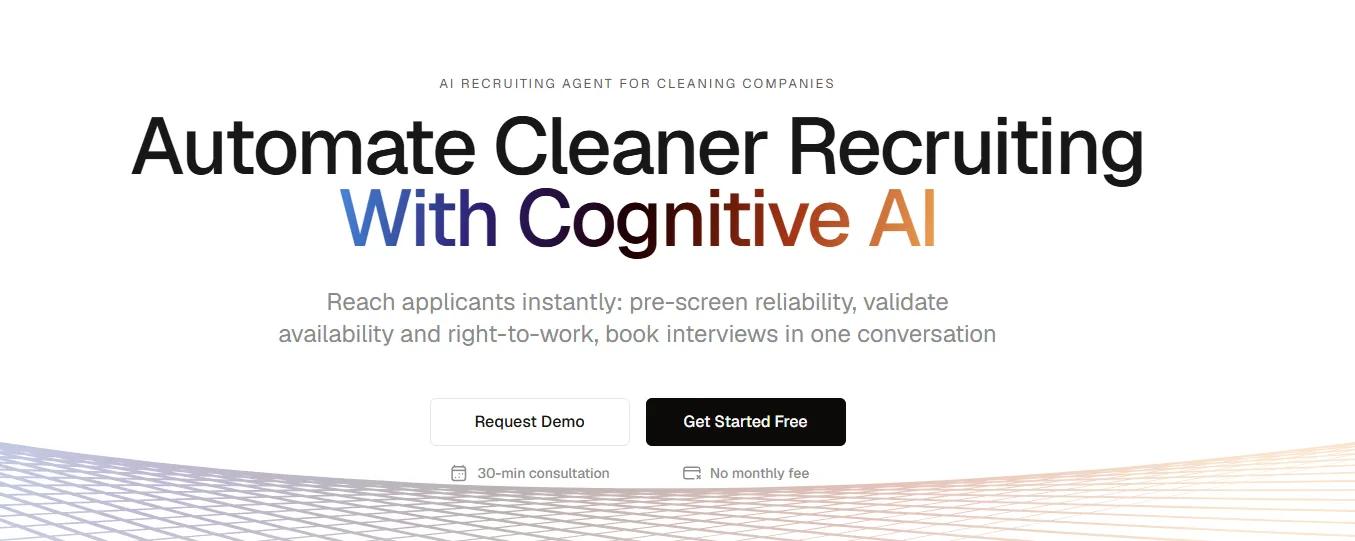
The cleaning industry has always depended on reliable workers, efficient scheduling, and fast hiring processes. Whether it is residential cleaning, commercial janitorial services, industrial sanitation, or hospitality housekeeping, staffing challenges remain one of the biggest obstacles for business owners. High turnover rates, seasonal demand, labor shortages, and time-consuming recruitment tasks often slow down growth and reduce profitability.
Today, artificial intelligence is changing the way cleaning companies hire employees. Advanced automation tools can now screen candidates, schedule interviews, communicate with applicants, and identify the best talent in far less time than traditional recruiting methods. As competition for workers increases, more companies are turning to an ai recruiting agent for cleaning companies to streamline hiring operations and improve workforce quality.
This shift is not just a trend. It represents a major transformation in how cleaning businesses manage talent acquisition in a fast-paced market.
The Growing Hiring Challenges in the Cleaning Industry
Cleaning businesses face unique recruitment difficulties compared to many other industries. The demand for cleaning services continues to rise due to growth in commercial real estate, healthcare facilities, schools, warehouses, and residential services. However, finding dependable workers has become increasingly difficult.
Several factors contribute to these hiring problems:
High employee turnover
Inconsistent applicant quality
Time-intensive manual screening
Last-minute staffing shortages
Seasonal demand fluctuations
Competition from other service industries
Limited HR resources for small businesses
Many cleaning company owners spend hours reviewing resumes, answering calls, conducting interviews, and coordinating schedules. For smaller businesses, these responsibilities often fall directly on owners or office managers who already manage operations, billing, customer service, and dispatching.
Traditional hiring methods simply cannot keep pace with modern staffing demands.
What Is an AI Recruiting Agent?
An AI recruiting agent is an intelligent software solution designed to automate and optimize recruitment workflows. Using artificial intelligence, machine learning, and natural language processing, these systems can perform many tasks that were once handled manually by recruiters or HR teams.
For cleaning companies, AI recruiting tools can:
Post job openings automatically
Screen resumes and applications
Rank candidates based on qualifications
Conduct preliminary interviews through chatbots
Schedule interviews automatically
Send reminders and follow-ups
Verify availability and work eligibility
Analyze hiring data and trends
Unlike standard recruiting software, AI-powered systems continuously improve through data analysis and pattern recognition. Over time, they become more accurate at identifying strong candidates who are likely to succeed and remain with the company longer.
As a result, many service businesses now rely on an ai recruiting agent for cleaning companies to reduce administrative work and accelerate hiring decisions.
Why Cleaning Companies Need Faster Hiring Processes
Speed is essential in the cleaning industry. When a business lands a new contract, it often needs workers immediately. Delays in recruitment can lead to:
Missed business opportunities
Overworked staff
Poor service quality
Customer dissatisfaction
Revenue loss
For example, commercial cleaning contracts frequently require rapid onboarding of multiple workers within days. Traditional hiring methods may take weeks, causing businesses to struggle with staffing gaps.
AI-driven recruiting systems help solve this problem by automating repetitive tasks and reducing delays between application submission and hiring decisions.
Instead of manually reviewing dozens or hundreds of applications, AI tools instantly filter candidates according to criteria such as:
Location
Availability
Experience level
Certifications
Language skills
Transportation access
Work authorization
This dramatically shortens the hiring cycle.
Improving Candidate Screening With Artificial Intelligence
One of the biggest advantages of AI recruiting systems is smarter candidate screening. Many cleaning companies receive large numbers of applications, but only a small percentage meet the actual job requirements.
Manual screening is slow and prone to human error. Important details may be overlooked, and qualified candidates can be missed entirely.
AI recruiting platforms analyze applications far more efficiently. They can identify patterns and match candidates based on:
Previous cleaning experience
Job stability
Relevant skills
Shift availability
Geographic proximity
Communication abilities
Some systems even assess soft skills through automated questionnaires or conversational chatbots.
This allows employers to focus only on the most promising applicants rather than spending hours reviewing unsuitable candidates.
Reducing Employee Turnover
Employee turnover is one of the costliest problems in the cleaning industry. Recruiting, onboarding, and training new employees repeatedly can consume substantial time and resources.
Artificial intelligence helps reduce turnover by improving hiring accuracy.
AI systems can analyze historical employee data to determine which traits correlate with long-term retention. These insights help businesses select candidates who are more likely to remain with the company.
For example, AI tools may discover that workers with certain availability patterns, commuting distances, or previous employment histories tend to stay longer. Recruiters can then prioritize similar candidates in future hiring cycles.
Using an ai recruiting agent for cleaning companies also improves communication during the hiring process, helping applicants stay engaged and reducing drop-off rates.
Automating Candidate Communication
Communication delays are a common problem in recruitment. Applicants may lose interest if they wait too long for responses or interview scheduling.
AI-powered recruiting assistants solve this issue through automated communication.
These systems can:
Respond instantly to inquiries
Send application confirmations
Answer common questions
Schedule interviews automatically
Provide onboarding instructions
Deliver reminders via text or email
Chatbots are particularly useful for cleaning companies because many applicants apply outside regular office hours. AI systems operate 24/7, ensuring candidates receive immediate engagement.
This creates a smoother applicant experience and increases the likelihood of successful hiring.
AI Chatbots and Virtual Recruiting Assistants
Virtual recruiting assistants have become increasingly sophisticated. Modern AI chatbots can conduct interactive conversations with candidates and gather important information automatically.
For example, a chatbot may ask:
Are you available for evening shifts?
Do you have reliable transportation?
Have you worked in commercial cleaning before?
Are you comfortable lifting heavy equipment?
Can you work weekends?
The chatbot can instantly evaluate responses and determine whether the candidate meets basic hiring criteria.
This automation saves recruiters enormous amounts of time while improving consistency in the screening process.
For businesses experiencing rapid growth, an ai recruiting agent for cleaning companies provides scalability without requiring additional HR staff.
Enhancing Diversity and Fairness in Hiring
Human bias can unintentionally influence hiring decisions. AI systems, when properly designed and monitored, can help create more objective recruitment processes.
Artificial intelligence evaluates candidates based on predefined criteria rather than subjective impressions. This can improve fairness and increase workforce diversity.
Cleaning companies often hire workers from varied cultural and linguistic backgrounds. AI recruiting systems can standardize evaluations to ensure applicants receive equal consideration.
However, businesses must still monitor AI tools carefully to ensure algorithms remain ethical and compliant with employment regulations.
Data-Driven Recruitment Decisions
Traditional hiring often relies on intuition or limited information. AI introduces data-driven decision-making into recruitment.
Recruiting platforms can generate valuable insights such as:
Which job boards produce the best candidates
Average hiring time
Candidate drop-off points
Retention rates by hiring source
Seasonal hiring trends
Most effective interview questions
These analytics help cleaning businesses optimize recruitment strategies over time.
For example, a company may discover that candidates recruited through mobile applications remain employed longer than those recruited through certain job boards. This information enables smarter allocation of recruiting budgets.
Mobile Recruitment for Frontline Workers
Most cleaning professionals rely heavily on smartphones rather than desktop computers. AI recruiting tools are increasingly mobile-friendly, allowing applicants to:
Apply quickly from phones
Complete screenings via text
Upload documents digitally
Schedule interviews instantly
Receive notifications in real time
Mobile optimization is especially important in industries with hourly and frontline workers.
A modern ai recruiting agent for cleaning companies often includes SMS-based communication features, making it easier to engage candidates who may not regularly use email.
This accessibility increases application completion rates and broadens the available talent pool.
Supporting Multi-Location Cleaning Businesses
Large cleaning companies with multiple locations face additional recruiting complexity. Each office may require different staffing levels, schedules, certifications, or language requirements.
AI recruiting systems help centralize and standardize hiring operations across multiple branches.
Benefits include:
Unified recruitment workflows
Consistent candidate evaluation
Shared applicant databases
Real-time staffing visibility
Automated regional job postings
Managers can quickly identify hiring gaps and allocate resources more efficiently across locations.
This level of coordination is difficult to achieve through manual recruitment processes alone.
Conclusion
Recruitment in the cleaning industry is becoming increasingly complex due to labor shortages, rising demand, and operational pressures. Traditional hiring methods often struggle to deliver the speed and efficiency modern businesses require.
Artificial intelligence offers a powerful solution. By automating repetitive tasks, improving candidate screening, accelerating communication, and providing valuable analytics, AI recruiting systems help cleaning companies build stronger and more reliable teams.
An ai recruiting agent for cleaning companies can significantly reduce administrative burdens while improving hiring quality and workforce stability. From small residential cleaning services to large commercial janitorial providers, businesses of all sizes can benefit from smarter recruitment technology.
As AI continues to evolve, companies that adopt intelligent hiring solutions will be better positioned to compete, grow, and deliver exceptional service in an increasingly demanding marketplace.